
Every March, Women’s History Month is a time to celebrate the women who built, created, fought, and led. This year’s theme: “Leading the Change: Women Shaping a Sustainable Future” from the National Women’s History Alliance honors women who are driving innovation to create a more equitable future. Dr. Wanda Diaz-Merced is doing just that. Born in Puerto Rico approximately in 1982, her story is one of perseverance, resilience, and creativity to continue her dream of becoming an Astronomer.
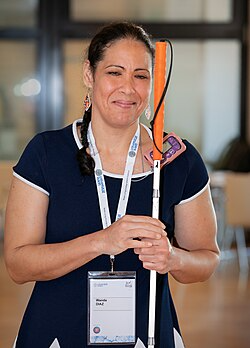 The astronomer who listens to the stars
While astronomers have been listening to the cosmos in one form or another since the 1930s, audio had not been in use in the field for many years until Puerto-Rican-born Wanda Díaz-Merced came on the scene. Determined to be a scientist but completely blind since her early 20s, due to complications with degenerative diabetic retinopathy. She found new ways to study stellar radiation without relying on her vision. Dr. Merced was driven to create a technique called “sonification” that converted astrophysical signals into sound so that she could fully participate in her chosen field of astronomy. Using audible sound to study astrophysical date, she used her ears to detect patterns in stellar radio data that could potentially be obscured in visual and graphical representation. She demonstrated that scientists are better able to detect black holes if they use a combination of audio and visual data.
For an astronomer who cannot see the stars, her career has been, well, stellar.
Dr. Diaz-Merced says she has been interested in science since she was a child, growing up in Puerto Rico. When it was time for her to enter university, she first wanted to study medicine. But her future took a dark turn. She had started to lose her eyesight as a teenager, and by the time she graduated from secondary school she was totally blind. “I couldn’t even see what the professor was writing on the board, and I obviously couldn’t read books anymore,” she recalls, referring to a critical period in her life when she almost gave up everything.
It was a classmate who saved her from the black hole of her disability. An amateur astronomer, he was contributing to a NASA participatory science project called Radio Jove, recording and analyzing radio transmissions from Jupiter, the Sun and the whole galaxy using a small make-it-yourself antenna. He had the young student listen to the transposition into audible frequencies of the radio signal from a solar flare. “I felt as though I were hearing the Sun in real time, and then, after the flare, the background sound of the galaxy,” she recalls, with a note of excitement. “I had the deep feeling that this was a possibility for me.”
Taking action, she became involved in the Radio Jove project. “I participated in teleconferences and learned as much as I could,” she recounts. Then in 2005 she was selected for a summer internship at the Goddard Space Flight Center in the United States, where she met Robert Candey, the astrophysicist whom she still considers her mentor nearly 20 years later. With Candey, she began working on the development of a program called xSonify, which translates signals from astrophysical objects into variations in audio frequency and intensity. “It allowed me to analyze my first data from a radio telescope,” Dr. Diaz-Merced explains.
The following year she worked on recordings made by the Swift satellite of gamma-ray bursts, flashes of high-energy photons emitted by the fusion of neutron stars or the explosion of giant stars. “That’s when I realized that astronomy was a science that I could work in,” she says.
After studying physics at the NASA Goddard Space Flight Center, Dr. Díaz-Merced received a doctorate in computer science from the University of Glasgow and accepted a post-doctoral fellowship at the Center for Astrophysics Harvard & Smithsonian, where she later collaborated on a music album based on her audio representations. Composed by Volkmar Studtrucker, “X-Ray Hydra” includes nine pieces of music derived from NASA’s Chandra X-Ray Observatory rendered as sound.
She has also worked at the National Astronomical Observatory Japan and the South African Observatory’s Office of Astronomy for Development. After spending a year at the European Gravitational Observatory Casina, Italy, in August 2024 she began a one-year residency in Paris, where she is pursuing her unique endeavor to make signals from the sky accessible to all.
As she points out, “Sonification cannot replace meticulous mathematical analysis, but it’s a way of accessing data that can identify potentially significant signals for subsequent in-depth study.” Better still, the researcher has been able to show, through a series of perceptual experiments, that even for sighted astronomers under professional working conditions, sound enhances the ability to access very weak signals that are by nature invisible to the human eye.
Remember the eclipse of 2023? Dr. Díaz-Merced had years earlier collaborated with Harvard astronomer Allyson Bieryla to develop the “LightSound” device that translates changing light intensity into musical tones that change as the sky grows dark and brightens again. Since refined, this device allowed individuals without sight to experience this major solar eclipse. Today she travels the world to study and promote equal access to astronomy, no matter a person’s disability. She co-chaired the 2019 conference Astronomy for Equity, Diversity, and Inclusion at the National Astronomical Observatory of Japan.
Her advice to young people? Keep your focus until you become victors in your mission. “Not giving up is really hard,” she says, “but just keep moving forward, find good mentors and be a good mentee.” (Taken from the National Center for Women’s Innovations, 2025, Wikipedia, and CNRS News, article entitled, Wanda Diaz-Merced, the Astronomer who listens to the stars, by Mathieu Grousson, 2023).
https://youtu.be/-hY9QSdaReY?si=fiGUMZ7mtBw8lPoV How a blind astronomer found a way to hear the stars, Dr. Wanda Diaz Merced, Ted Talk, 11:15 minutes, 2016.
https://youtu.be/S8qMpohp23k?si=cOLKz9Ih8D7AxfQ- This Blind Astrophysicist ‘Sees’ the Universe in the Most Amazing Way, Short Film Showcase, National Geographic, 5:35 minutes, 2017.
https://youtu.be/97rk4IbcaY4?si=cWWxCm1r20Zq5GNI Making Astronomy Accessible for the Visually Impaired, 2:31 minutes, Interview with Dr. Wanda Diaz Merced, South African Broadcasting Corporation (SABC), 2015.
https://youtu.be/Mho8uryWcsM?si=mZLVmCDYvBm7Qj52 Wanda Diaz Merced at the United Nations, Ego and the Virgo Corporation, 5:27 minutes, 2022.